
Steady background sounds like rain, white noise or the hum of a café mask the sudden noises that pull your attention away, such as voices, doors and traffic. Research suggests they help most in noisy places and for people who find it hard to focus in silence, while speech and song lyrics are the most distracting sounds of all. Keep the volume low to moderate.
Why a steady sound helps
Your brain is tuned to notice change. A constant hum fades into the background within minutes, but a door slamming or someone saying your name grabs your attention instantly. A steady sound raises the background level, so those sudden noises stand out less. That's called masking, and it's why many people focus better with rain in their headphones than in a “quiet” office full of small noises.
What the research says
Speech is the biggest distraction
Hearing speech, even speech you're trying to ignore, makes it harder to remember words and numbers. Psychologists call this the irrelevant speech effect, and it has been shown in experiments since the 1970s (Colle and Welsh, 1976; Salamé and Baddeley, 1982). It's why a colleague's phone call is so much more distracting than air conditioning, and why lyrics can get in the way of reading.
A moderate level can help creative work
In five experiments, a moderate level of ambient noise, about 70 decibels, like a busy café, improved performance on creative tasks compared with a quiet 50 decibels. A loud 85 decibels made it worse (Mehta, Zhu and Cheema, 2012).
White noise helps some people more than others
In a 2007 study, white noise improved memory performance in children with attention problems, while children without them did better in silence (Söderlund, Sikström and Smart). Later studies found similar patterns: background noise seems to help people who find it hard to concentrate and can slightly hurt people who don't. If silence works for you, you don't need sound.
Nature sounds are easy to live with
There's less hard evidence that rain or a forest helps you focus more than other steady sounds. But natural sounds are pleasant to listen to for a long time, and most people find them far less tiring than a harsh hiss.
Which sound to choose
| Sound | What it's like | Good for |
|---|---|---|
| White noise | An even hiss across all frequencies, like a detuned radio | Covering voices in an office, library or dorm |
| Pink noise | Softer at the top end, like steady rain or wind | Long sessions; many find it gentler than white noise |
| Brown noise | A deep rumble, like a waterfall or distant thunder | Covering low hums and traffic; popular with people with ADHD |
| Rain | Natural, close to pink noise, with gentle variation | Reading, writing, studying |
| Waterfall | Steady rushing water | Masking chatter |
| Forest | Leaves, wind and birds, with more variation | Lighter work and calm breaks |
| Campfire | A soft, irregular crackle | Cozy evening sessions |
| Thunderstorm | Rain with occasional deep rumbles | If you like drama; the rumbles can startle some people |
| Café or office | The murmur and clatter of a busy room | Creative work, or if you miss the buzz of an office |
How to use focus sounds
- Keep it quiet. Low to moderate, about as loud as a quiet conversation or softer. If you'd have to raise your voice to talk over it, turn it down. The World Health Organization's safe listening guidance for adults is to keep headphone listening under 80 decibels, for no more than 40 hours a week.
- Pick one and stick with it. A familiar sound becomes a cue: when the rain starts, it's time to work.
- Pair it with a timer. Sound during focus, silence (or a different sound) during breaks makes the rhythm easy to feel.
- Give your ears a break. Take headphones off during long breaks.
- Try before you decide. Give a sound a few sessions. The right one is the one you forget is playing.
Music or ambient sound?
For reading, writing and memorizing, music with lyrics is usually the worst option, because the words compete with the words you're working on. Instrumental music, especially something familiar and not too busy, is fine for many people. For routine or physical tasks, play whatever keeps you going.
If you're using iOS's built-in sounds instead, you'll find them under Settings › Accessibility › Audio & Visual › Background Sounds.
Focus sounds in Pomodoro Focus
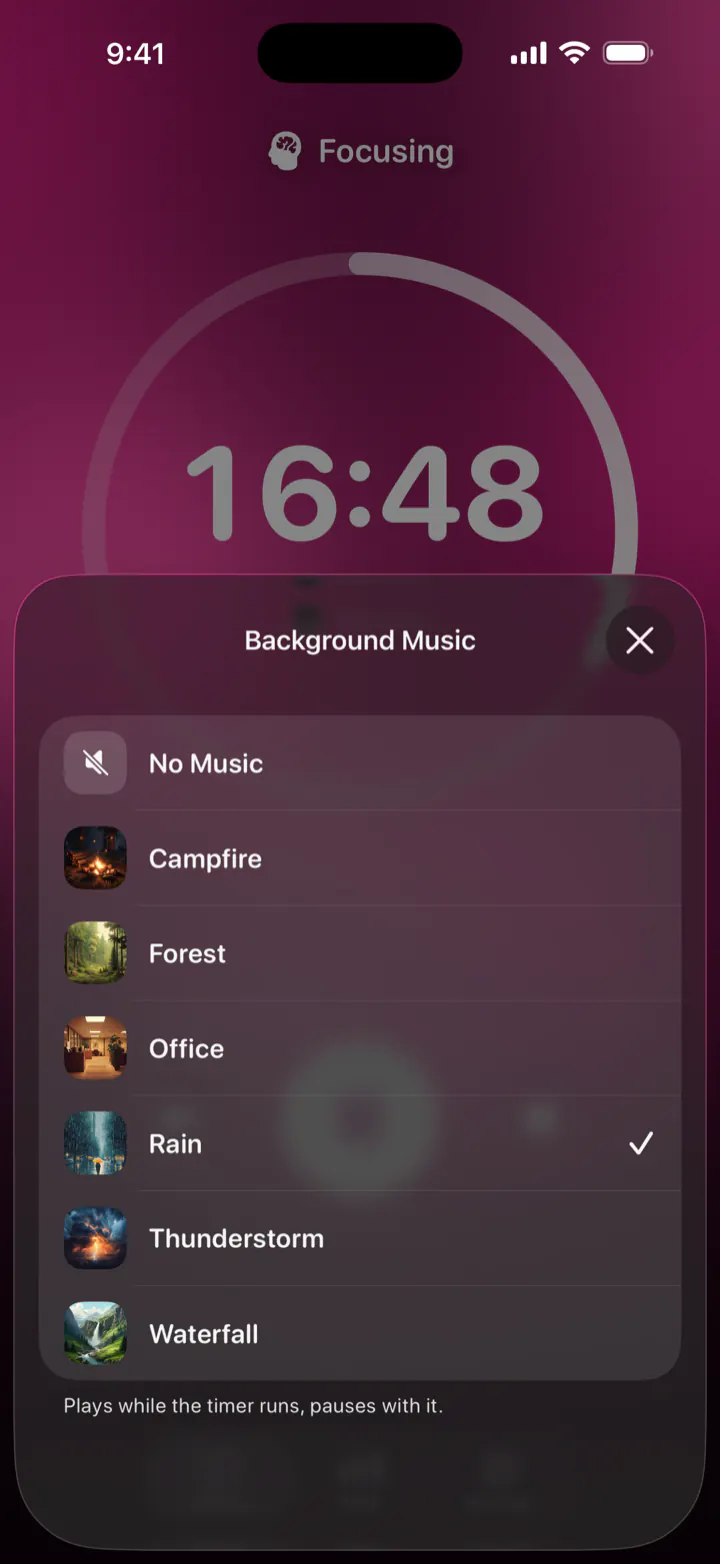
Pomodoro Focus has six ambient sounds built in: rain, forest, campfire, waterfall, thunderstorm and office. Tap the speaker button on the focus screen to choose one. It plays while the timer runs and pauses with it, keeps playing with your iPhone locked, and mixes with other audio, so you can keep your own music on too.
Questions
Is rain or white noise better for studying?
Both mask distractions. White noise is better at covering voices; rain is softer, and many people find it easier to listen to for hours. Try each for a few sessions and keep the one you forget is playing.
Is brown noise good for ADHD?
Many people with ADHD say brown noise helps them focus, and studies have found that white noise can help people with attention problems. Research on brown noise itself is limited, but it's easy to try: if it helps you, use it.
Should I listen to music with lyrics while working?
For reading, writing and memorizing, it's better not to: the words in a song compete with the words you're working on. Lyrics matter less for routine or physical tasks.
How loud should focus sounds be?
Low to moderate, about as loud as a quiet conversation or softer. If you'd need to raise your voice to talk over it, turn it down.
Can focus sounds play with the screen locked?
Yes. In Pomodoro Focus the sound keeps playing while the timer runs, with your iPhone locked or while you use other apps, and it pauses when you pause the timer.
Sources
- Colle, H. A. and Welsh, A. (1976). Acoustic masking in primary memory. Journal of Verbal Learning and Verbal Behavior 15(1): 17–31.
- Salamé, P. and Baddeley, A. (1982). Disruption of short-term memory by unattended speech. Journal of Verbal Learning and Verbal Behavior 21(2): 150–164.
- Mehta, R., Zhu, R. and Cheema, A. (2012). Is noise always bad? Exploring the effects of ambient noise on creative cognition. Journal of Consumer Research 39(4): 784–799. doi:10.1086/665048
- Söderlund, G., Sikström, S. and Smart, A. (2007). Listen to the noise: noise is beneficial for cognitive performance in ADHD. Journal of Child Psychology and Psychiatry 48(8): 840–847.
- World Health Organization and International Telecommunication Union (2019). Safe listening devices and systems: a WHO-ITU standard.